
久久久精品五月天_亚洲免费在线精品一区_国产精品一区二区在线观看不卡_国产日韩欧美一区二区三区在线观看_欧美片网站免费_欧美 日韩 国产一区二区在线视频_亚洲国产欧美一区二区三区久久_国产色综合天天综合网_韩日精品视频一区_亚洲全部视频_国产欧美精品国产国产专区_亚洲图色在线_黑人巨大精品欧美黑白配亚洲_亚洲一区二区毛片_亚洲一区二区三区在线观看视频_欧美性久久久

Why investing in X-ray inspection systems pays off Detect foreign objects or monitor fill levels: X-ray inspection systems are suitable for many applications in industry.

The use of X-ray inspection systems in the food industry has increased considerably over the last few years. The systems have proven to be a good investment in product safety, integrity and quality. Their ability to detect foreign objects in products and reliably reject them from the production or packaging line promotes compliance with industry standards such as HACCP, IFS and BRC, protects brand image and helps avoid costly product recalls.

X-ray inspection systems not only detect products contaminated with metal, glass, rubber, stones, plastic parts or bone chips. They also allow inline quality checks, including weight determination, counting of components, detection of missing or defective products, fill level monitoring and checking the integrity of closures.

Product Portfolio X-ray systems

We offer a wide portfolio of X-ray inspection systems

All our X-ray units are characterised by the following product features:  
? Intuitive operation via an icon-based user interface

? High detection performance at high belt speeds

? Multi-track solutions for up to 8 lines with one detector

? Integrated networking compatibility enables remote access by technicians

? Powerful interfaces, including USB and Ethernet, facilitate integration into data networks. Optionally also via OPC-UA and SPC@Enterprise


Request advice now

Top or sideshooter: Which X-ray inspection system is right for you? Topshooter X-ray inspection systems: Effective inspection of flat individual packages

The top-down shooter is the most common system in X-ray food inspection. X-ray inspection systems are usually located at the end of the packaging line and inspect flat individual packages. Since the shallower product depth of the flat packages allows for better detection sensitivity, vertical inspection is most suitable here. As a rule, the X-ray inspection system at this point of the packaging line has its own conveyor belt and an integrated reject system.

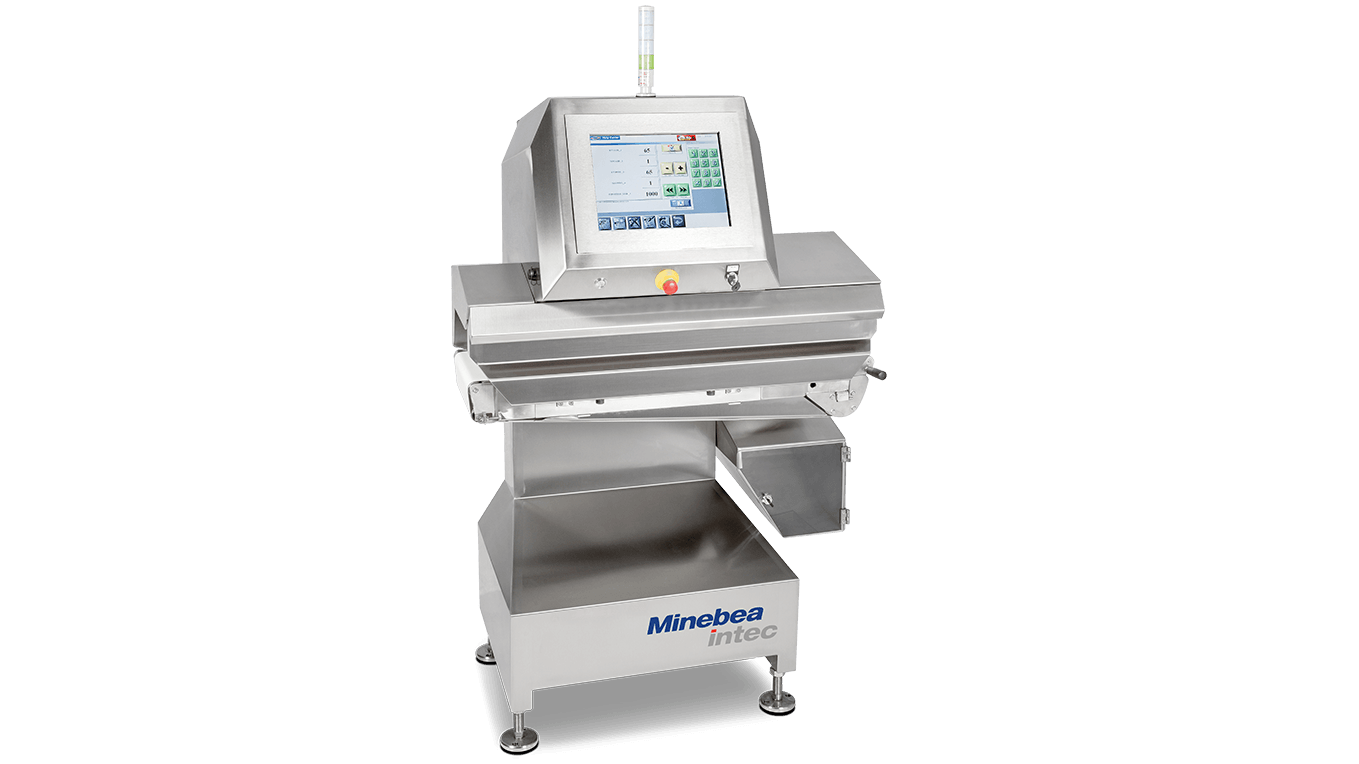
Sideshooter X-ray inspection systems: The optimal choice for products with greater height

The sideshooter X-ray inspection systems are used for packaged products whose height exceeds their width. Here, too, the premise is to guide the product with its flattest side through the X-ray beam. A sideshooter X-ray inspection system has an X-ray generator that scans the product parallel to the surface and across the direction of travel of the conveyor belt. The advantage of these systems is that an existing conveyor belt can be reused, as it is not visible in the inspection area of the X-ray beam. There is no need for additional transfer points between the conveyor belt and the drive. This also simplifies installation and integration into an existing packaging line.

X-ray inspection systems for bulk material

For all goods that are introduced "directly from the field" into the production process, Dymond Bulk offers the possibility of efficient detection and elimination of foreign bodies of all kinds.

X-ray inspection system Dymond Bulk

About the product

FAQs

White Paper

Find out more details about X-ray inspection technology in our white paper "X-ray inspection in food production: requirements, technology and application recommendations".

To free download

X-ray inspection system Dylight

As a true "plug and play" solution, the Dylight X-ray inspection system combines all functions in one compact unit. It is perfect for inspecting small products such as snacks, energy bars and sweets. Further product features:


About the product

X-ray inspection system Dymond 40/80/120/160

The Dymond series of X-ray inspection systems are exceptionally versatile. 4 models offer solutions for the most common applications for inspecting packaged products. With belt widths up to 800 mm, it is additionally suitable for multi-track applications of maximum 8 tracks.


About the product

X-ray inspection system Dypipe

With Dypipe we guarantee a new level of safety and flexibility in your production process of viscous and liquid products. The system can be equipped with various separators, connections and mounting options that offer unsurpassed flexibility and make it the perfect solution for your production line. An innovative test part feeder ensures the highest quality on the fly during operation.

About the product

X-ray inspection system Dymond S

The Dymond S X-ray inspection system combines high detection sensitivity with low energy consumption. Optionally, the unit can be supplied in a curved configuration. Ideal for all situations with severely limited space. All Dymond S come standard with...

About the product

X-ray inspection system Dymond D

Dymond D is an X-ray inspection system that produces two X-ray images at an angle of 90° degrees. Whether it's a can, a Tetra Pak or a glass jar - the maximum security provided by multi-sided fluoroscopy opens up many possibilities in product design for manufacturers.


About the product

How long have X-ray inspection systems been around and in which areas are they used?

Since Wilhelm Conrad Rontgen discovered the "invisible rays" on 8 November 1895, X-ray diagnostics has become established in many areas. Today, X-rays are not only used for medical purposes, but also support the food industry in its quest for food quality and safety.

X-ray technology offers a reliable method for food inspection. It is used to detect physical foreign objects or to examine the internal structure of food. As part of the HACCP concept (Hazard Analysis and Critical Control Points), it helps to meet the increasing demands of consumers and regulatory authorities. An X-ray inspection system can identify a variety of physical foreign objects such as metals, glass, rubber, stones and even certain types of plastics. Taking an X-ray image leaves no trace on the product. Therefore, this method is preferred for packaged finished products - especially those in bottles, cans, jars and bags. X-ray inspection systems have become more powerful, reliable and user-friendly in recent years. Some systems not only detect foreign objects, but also check the weight, the number of product components, the fill heights or the seal seam integrity of the packaging. Thanks to their technological progress, modern X-ray inspection systems thus contribute to a reduction in production costs.

How does an X-ray inspection system work in industry?

A Rontgen inspection system consists of the three core components generator, detector and image processing as well as mechanics and conveyor technology. Special hardware configurations are available for different areas of application, enabling the core components to be used in a wide variety of applications.

Structure of a generator

In their simplest form, modern X-ray tubes consist of the following components:

All components lie within a vacuum in a sealed glass or ceramic body. The heating cathode serves as the electron source and consists of a tungsten filament that is made to glow by an electric current.

By applying a high voltage (kV) between the copper anode and the heating cathode, electrons are accelerated and move towards the tungsten disc. The electron current at this point is called the X-ray tube current (mA). When the electrons hit the tungsten disc, they are slowed down considerably. This deceleration causes the emission of X-rays. In an X-ray generator

the tube is shielded with lead or copper. The usable X-rays leave the generator through a small opening (see red waves in the graphic).

The generation of usable X-ray radiation releases heat and makes it necessary to cool the generator. Therefore, the X-ray generator is often located in a housing that is filled with a cooling liquid such as oil. The dissipation of heat is often enhanced by cooling fins. The cooling requirement results from the power of the generator and the ambient temperature.

Generally speaking:

Search sensitivities of X-ray inspection systems in the food industry environment

X-ray inspection looks for foreign bodies that absorb a higher amount of radiation than the product being inspected. Reliable detection of foreign bodies is therefore only possible if they have a comparatively higher density.

Many foods are water-based or based on water due to their natural structure, such as fruit and vegetables. Thus, they have a similar density to water (1000 kg / m3). In terms of specific gravity, this corresponds to a value of 1.0 g / cm3. This value is usually used as a reference point.

The following table illustrates the detectability of material types. Materials marked in red cannot normally be detected because their density is too low or almost the same as that of the product. Materials marked in green can be detected due to their higher density. The table is sorted in descending order of density. The higher a material is in the table, the higher the attenuation factor and thus these elements are better detected in the food. This also means that smaller particles can also be detected more easily.

Caution: When defining detection sensitivities for the quality management system, the density of the materials that pose a risk according to the risk analysis should also be specified. For example, not all glass is the same: lead glass, for example, has a density of 3.5 - 4.8 g / cm3. In contrast, soda-lime glass (also called soda-lime-silica glass, the most common material for glass containers such as

bottles or glass jars) have a density of 2.52 g / cm3. It is obvious that the absolute detection sensitivity of these two types of glass differs greatly. Therefore, care must be taken that for the definition of search sensitivities of an X-ray inspection device exactly those materials are evaluated which actually exist as a risk in the production environment.

Why investing in X-ray inspection systems pays off Detect foreign objects or monitor fill levels: X-ray inspection systems are suitable for many applications in industry.

The use of X-ray inspection systems in the food industry has increased considerably over the last few years. The systems have proven to be a good investment in product safety, integrity and quality. Their ability to detect foreign objects in products and reliably reject them from the production or packaging line promotes compliance with industry standards such as HACCP, IFS and BRC, protects brand image and helps avoid costly product recalls.

X-ray inspection systems not only detect products contaminated with metal, glass, rubber, stones, plastic parts or bone chips. They also allow inline quality checks, including weight determination, counting of components, detection of missing or defective products, fill level monitoring and checking the integrity of closures.

We offer a wide portfolio of X-ray inspection systems

All our X-ray units are characterised by the following product features:  
? Intuitive operation via an icon-based user interface

? High detection performance at high belt speeds

? Multi-track solutions for up to 8 lines with one detector

? Integrated networking compatibility enables remote access by technicians

? Powerful interfaces, including USB and Ethernet, facilitate integration into data networks. Optionally also via OPC-UA and SPC@Enterprise


Request advice now

Top or sideshooter: Which X-ray inspection system is right for you? Topshooter X-ray inspection systems: Effective inspection of flat individual packages

The top-down shooter is the most common system in X-ray food inspection. X-ray inspection systems are usually located at the end of the packaging line and inspect flat individual packages. Since the shallower product depth of the flat packages allows for better detection sensitivity, vertical inspection is most suitable here. As a rule, the X-ray inspection system at this point of the packaging line has its own conveyor belt and an integrated reject system.

X-ray inspection system Dylight

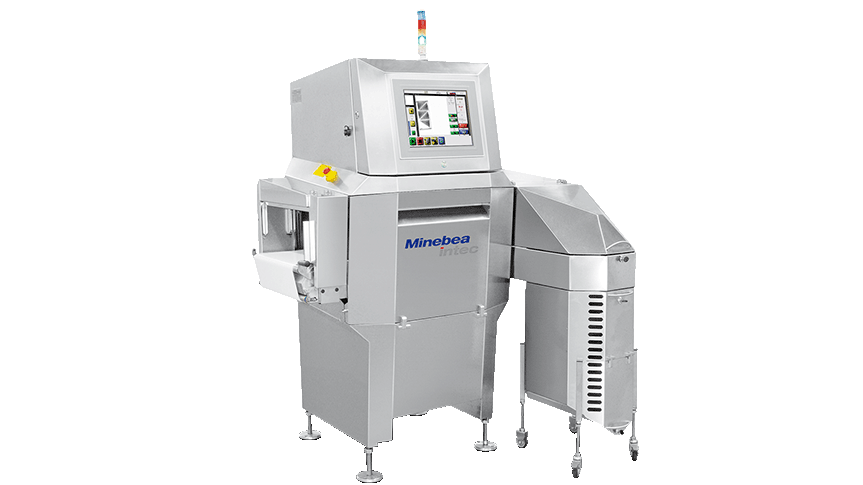
As a true "plug and play" solution, the Dylight X-ray inspection system combines all functions in one compact unit. It is perfect for inspecting small products such as snacks, energy bars and sweets. Further product features:

  • With a width of only 1 metre, the extremely narrow unit can be integrated into your packaging line even if you only have very little space available
  • Complete with integrated separator and collection container for contaminated or defective products


About the product

X-ray inspection system Dymond 40/80/120/160

The Dymond series of X-ray inspection systems are exceptionally versatile. 4 models offer solutions for the most common applications for inspecting packaged products. With belt widths up to 800 mm, it is additionally suitable for multi-track applications of maximum 8 tracks.

  • Reliable inspection thanks to high detection sensitivity
  • Maximum safety: Dymond detects foreign bodies and checks fill levels
  • Simple integration via SPC@Enterprise, OPC-UA, Modbus and Ethernet


About the product

X-ray inspection system Dypipe

With Dypipe we guarantee a new level of safety and flexibility in your production process of viscous and liquid products. The system can be equipped with various separators, connections and mounting options that offer unsurpassed flexibility and make it the perfect solution for your production line. An innovative test part feeder ensures the highest quality on the fly during operation.

  • Elbow valve separator in hygienic design
  • Multiple interfaces such as OPC UA, Ethernet IP and SPC@Enterprise pave the way to more productivity
  • Easy-opening arc valve separator (ABV) specially designed for meat applications.
  • Product learning mode and individual operating levels provide maximum flexibility and ease of use.

About the product

Sideshooter X-ray inspection systems: The optimal choice for products with greater height

The sideshooter X-ray inspection systems are used for packaged products whose height exceeds their width. Here, too, the premise is to guide the product with its flattest side through the X-ray beam. A sideshooter X-ray inspection system has an X-ray generator that scans the product parallel to the surface and across the direction of travel of the conveyor belt. The advantage of these systems is that an existing conveyor belt can be reused, as it is not visible in the inspection area of the X-ray beam. There is no need for additional transfer points between the conveyor belt and the drive. This also simplifies installation and integration into an existing packaging line.

X-ray inspection system Dymond S

The Dymond S X-ray inspection system combines high detection sensitivity with low energy consumption. Optionally, the unit can be supplied in a curved configuration. Ideal for all situations with severely limited space. All Dymond S come standard with...

  • ...an integrated Nema 4X cooler for easy cleaning
  • ...a 500 W monobloc generator for high throughput rates and low installation and maintenance effort
  • ...a chicane for product guidance and shielding.

About the product

X-ray inspection system Dymond D

Dymond D is an X-ray inspection system that produces two X-ray images at an angle of 90° degrees. Whether it's a can, a Tetra Pak or a glass jar - the maximum security provided by multi-sided fluoroscopy opens up many possibilities in product design for manufacturers.

  • Maximum inspection power through dual beam technology: 2 × 90 kV, 9 mA
  • Dymond D is equipped with a customised product feed, baffle and shielding device.


About the product

X-ray inspection systems for bulk material

For all goods that are introduced "directly from the field" into the production process, Dymond Bulk offers the possibility of efficient detection and elimination of foreign bodies of all kinds.

X-ray inspection system Dymond Bulk

  • Excellent detection performance for raw materials such as vegetables, nuts, dried fruits or cereals
  • Highest detection sensitivity for product and machine safety
  • Intuitive operation
  • Worldwide service, including remote support
  • Powerful interfaces for easy integration into networks

About the product


FAQs

How long have X-ray inspection systems been around and in which areas are they used?

Since Wilhelm Conrad Rontgen discovered the "invisible rays" on 8 November 1895, X-ray diagnostics has become established in many areas. Today, X-rays are not only used for medical purposes, but also support the food industry in its quest for food quality and safety.

X-ray technology offers a reliable method for food inspection. It is used to detect physical foreign objects or to examine the internal structure of food. As part of the HACCP concept (Hazard Analysis and Critical Control Points), it helps to meet the increasing demands of consumers and regulatory authorities. An X-ray inspection system can identify a variety of physical foreign objects such as metals, glass, rubber, stones and even certain types of plastics. Taking an X-ray image leaves no trace on the product. Therefore, this method is preferred for packaged finished products - especially those in bottles, cans, jars and bags. X-ray inspection systems have become more powerful, reliable and user-friendly in recent years. Some systems not only detect foreign objects, but also check the weight, the number of product components, the fill heights or the seal seam integrity of the packaging. Thanks to their technological progress, modern X-ray inspection systems thus contribute to a reduction in production costs.

How does an X-ray inspection system work in industry?

A Rontgen inspection system consists of the three core components generator, detector and image processing as well as mechanics and conveyor technology. Special hardware configurations are available for different areas of application, enabling the core components to be used in a wide variety of applications.

Structure of a generator

In their simplest form, modern X-ray tubes consist of the following components:

  • Glass envelope

  • Heating cathode

  • Copper anode

  • Tungsten disc

All components lie within a vacuum in a sealed glass or ceramic body. The heating cathode serves as the electron source and consists of a tungsten filament that is made to glow by an electric current.

By applying a high voltage (kV) between the copper anode and the heating cathode, electrons are accelerated and move towards the tungsten disc. The electron current at this point is called the X-ray tube current (mA). When the electrons hit the tungsten disc, they are slowed down considerably. This deceleration causes the emission of X-rays. In an X-ray generator

the tube is shielded with lead or copper. The usable X-rays leave the generator through a small opening (see red waves in the graphic).

The generation of usable X-ray radiation releases heat and makes it necessary to cool the generator. Therefore, the X-ray generator is often located in a housing that is filled with a cooling liquid such as oil. The dissipation of heat is often enhanced by cooling fins. The cooling requirement results from the power of the generator and the ambient temperature.

Generally speaking:

  • for X-ray detectors from 65W to 100W, simple fans are sufficient for circulating the warm air

  • Powerful air conditioners are used for units from 100W to 320W output.

  • for high power detectors with 1000W and more, a pump system with active water cooling is required.

Search sensitivities of X-ray inspection systems in the food industry environment
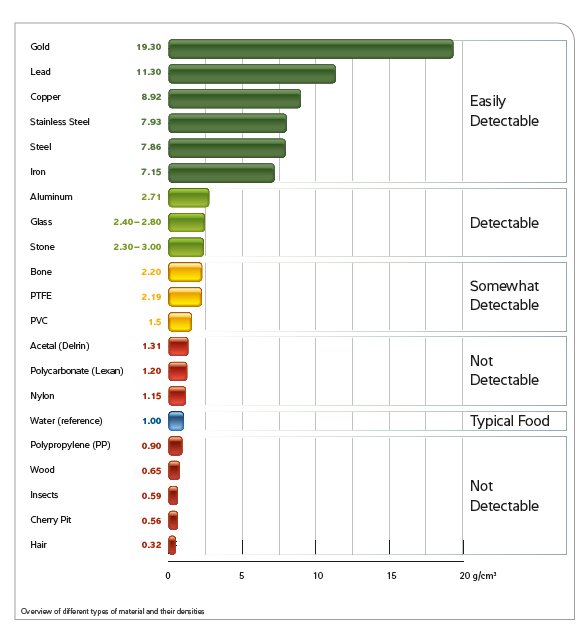
X-ray inspection looks for foreign bodies that absorb a higher amount of radiation than the product being inspected. Reliable detection of foreign bodies is therefore only possible if they have a comparatively higher density.

Many foods are water-based or based on water due to their natural structure, such as fruit and vegetables. Thus, they have a similar density to water (1000 kg / m3). In terms of specific gravity, this corresponds to a value of 1.0 g / cm3. This value is usually used as a reference point.

The following table illustrates the detectability of material types. Materials marked in red cannot normally be detected because their density is too low or almost the same as that of the product. Materials marked in green can be detected due to their higher density. The table is sorted in descending order of density. The higher a material is in the table, the higher the attenuation factor and thus these elements are better detected in the food. This also means that smaller particles can also be detected more easily.

Caution: When defining detection sensitivities for the quality management system, the density of the materials that pose a risk according to the risk analysis should also be specified. For example, not all glass is the same: lead glass, for example, has a density of 3.5 - 4.8 g / cm3. In contrast, soda-lime glass (also called soda-lime-silica glass, the most common material for glass containers such as

bottles or glass jars) have a density of 2.52 g / cm3. It is obvious that the absolute detection sensitivity of these two types of glass differs greatly. Therefore, care must be taken that for the definition of search sensitivities of an X-ray inspection device exactly those materials are evaluated which actually exist as a risk in the production environment.

White Paper

Find out more details about X-ray inspection technology in our white paper "X-ray inspection in food production: requirements, technology and application recommendations".

To free download

Contact us

Sales and Service Support Inspection
+49.241.1827.0
久久久精品五月天_亚洲免费在线精品一区_国产精品一区二区在线观看不卡_国产日韩欧美一区二区三区在线观看_欧美片网站免费_欧美 日韩 国产一区二区在线视频_亚洲国产欧美一区二区三区久久_国产色综合天天综合网_韩日精品视频一区_亚洲全部视频_国产欧美精品国产国产专区_亚洲图色在线_黑人巨大精品欧美黑白配亚洲_亚洲一区二区毛片_亚洲一区二区三区在线观看视频_欧美性久久久
欧美日韩中文字幕日韩欧美| 亚洲第一中文字幕在线观看| 亚洲视频在线观看日本a| 精品久久久91| 午夜国产福利一区二区| 日韩欧美中文字幕公布| 国产三级中文字幕| 91精品国产综合久久香蕉最新版| 婷婷久久综合九色国产成人| 中文字幕国产视频| 日本精品国语自产拍在线观看| 中文字幕人成乱码在线观看| 亚洲一区激情| 日韩在线精品视频| 视频一区二区不卡| 在线一区免费| 韩国一区二区av| 91精品视频观看| 国产在线一在线二| av免费网站在线观看| 午夜av一区| 一区二区高清视频| 在线精品视频免费播放| 日韩精品视频在线观看视频| 久久精品免费在线观看| 欧美日韩在线视频免费观看| 在线一区二区不卡| 精品一性一色一乱农村| 在线观看av的网站| 欧美日韩中文国产| 欧美中文字幕视频| 国产天堂素人系列在线视频| 国产三级免费观看| 日韩在线不卡| 美国av一区二区| 中文字幕日韩欧美| 91久久久久久久久| 亚洲va韩国va欧美va精品| 国产欧亚日韩视频| 中文字幕在线高清| 欧美日韩精品不卡| 日韩视频一区在线观看| 中文字幕 乱码 中文乱码91| 久久中文精品| 日韩专区视频网站| 亚洲最新免费视频| 中文字幕精品在线视频| 一本大道一区二区三区| 成人福利一区| 视频一区二区中文字幕| 色猫猫国产区一区二在线视频| 日韩av综合在线观看| 日韩不卡在线播放| 99在线精品视频免费观看20| 综合图区亚洲白拍在线| 日韩三级精品电影久久久| 香蕉视频亚洲一级| 九九视频精品免费| 国产成人精品三级| 国内精品露脸在线视频播放| 国产在线拍偷自揄拍精品| 国产欧美日韩精品高清二区综合区| 欧美日韩亚洲综合在线| 国产欧美日韩视频| 日本黄色一区二区| 亚洲一区二区三区精品中文字幕| 久久91精品视频| 日本xxxwww免费视频| 午夜伦欧美伦电影理论片| 中文字幕 亚洲视频| 午夜视频在线观看一区| 黄色国产在线| 久久久91精品国产| 国产裸舞福利在线视频合集| 欧美日韩精品在线| 久久久水蜜桃| 久久韩国免费视频| av免费看在线| 欧美日韩国产在线观看| 中文字幕在线视频网| 精品久久人人做人人爽| 久久精品国产成人一区二区三区| 国产综合成人久久大片91| 韩日中文字幕第一页| 欧美一级日韩不卡播放免费| 久久99久久久久久久噜噜| 免费视频最近日韩| 日韩在线二区| 亚洲免费中文字幕| 在线日韩精品视频| 免费视频最近日韩| 欧美日韩精品中文字幕| 日韩在线视频网| 国产资源在线观看| 樱花草www在线观看| www日韩在线观看| 久久精品久久精品亚洲人| 91欧美日韩麻豆精品| 日韩在线视频一区| 欧美日韩精品免费| 在线免费视频一区二区| 亚洲欧美中文在线视频| 一级特黄大欧美久久久| 久久精品人妻一区二区三区| 国产自产视频| 国产福利精品导航| 中文字幕第一页在线播放| 91精品国产综合久久久蜜臀粉嫩| 亚洲va中文字幕| 久久91精品久久久久久秒播| 中文在线不卡视频| 国产999精品在线观看| 欧美日韩中文字幕在线| 国产成人精品免费久久久久| 欧美不卡一二三| 国产日韩在线亚洲字幕中文| 精品欧美不卡一区二区在线观看| 精品999在线| 亚洲精品欧美二区三区中文字幕| 欧美日韩在线播放一区| 日韩三级高清在线| 亚洲成年人影院在线| 不卡专区在线| 日韩精品视频网| 91精品国产乱码久久蜜臀| 国产在线日韩欧美| 国产福利三区| 国产拍揄自揄精品视频麻豆| 国产福利在线播放| 91精品国产91久久久久青草| 久久视频www| 美日韩精品免费视频| 成人xxxx| 一区二区不卡久久精品| 天堂精品高清1区2区3区| 国产欧美日韩中文久久| 日本亚洲欧美天堂免费| 亚州黄色一级| 欧美日韩中文字幕在线| 中文字幕亚洲二区| 亚洲二区自拍| 日韩精品在线网站| 二区中文字幕| 中文字幕 日韩 欧美| 日韩欧美中文字幕视频| 久久韩国免费视频| 日韩在线不卡一区| 一级片在线播放| 欧美亚洲免费高清在线观看| 中文字幕在线视频精品| 日韩中文字幕第一页| 日韩美女中文字幕| 在线国产99| 日韩欧美一级二级三级久久久| 欧美中文字幕在线观看视频| 中文字幕 乱码 中文乱码91| 国产 中文 字幕 日韩 在线| 国产在线观看色| 国产三级做爰在线观看| 日韩三级在线播放| 精品一区二区三区中文字幕在线| 欧美日韩精品综合| √天堂资源中文www| 日韩精品在线播放|